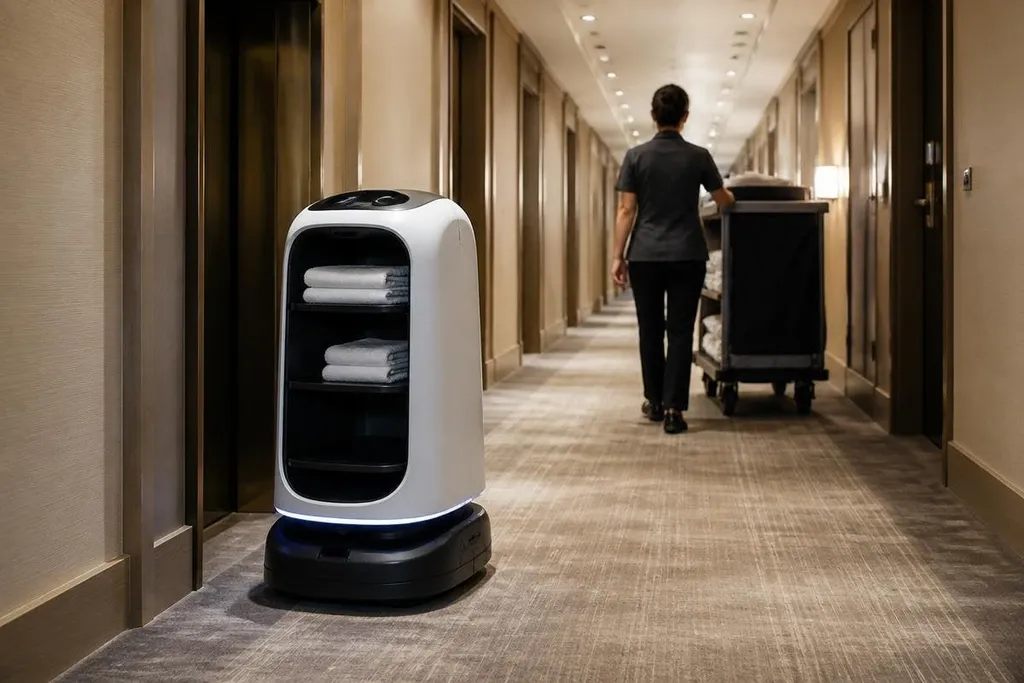
Room service robots may carry room service, move laundry, guide a guest, or clean a floor. The hard part is choosing a task where the robot saves staff time without making the guest experience slower or less personal.
The next phase of hotel automation will be judged in corridors, elevators, and service rooms. A polished demo won't answer the questions hotel managers need to ask about cost, safety, uptime, and staff workload.
Quick read
- Room delivery is a clearer first job than full room cleaning.
- Doors, elevators, guests, and dropped items create the hard cases.
- A robot earns its place when it cuts walking time without adding service calls.
Where hotel robots fit
Hotels contain many repeat jobs. Staff carry items between fixed points, check the same areas, answer routine requests, and move supplies through buildings that may stay busy all day.
That makes transport a sensible place to start. A robot can carry towels, food, or toiletries between a service area and a room floor, then return for another trip. The task has a clear beginning and end, and a supervisor can check whether the handoff worked.
Guest-facing work needs more care. A robot that gives directions must understand where the guest wants to go. A delivery robot must reach the correct room, wait for the guest, and handle a failed handoff. Those steps involve people, not fixed shelves.
Cleaning raises a different problem. Floors and rooms change between visits. Bags, chairs, luggage, wet patches, and people can block the planned route.
Floor-cleaning robots may still work in hotels, but they need a clear area and a staff process for the places they cannot reach.
The building is part of the robot
The building shapes the robot's work. Its results depend on doors, lifts, floor plans, charging points, Wi-Fi, and staff instructions.
An autonomous mobile robot uses sensors and software to move without a person steering it at every moment. In a hotel, that system must handle narrow corridors, reflective surfaces, glass doors, uneven thresholds, and guests who stop in front of it.
Elevators are a useful test. If the robot cannot call a lift, enter it, select a floor, and leave without help, staff may still need to escort it. That can remove much of the time saving from a delivery job.
The handoff matters too. A room number on a screen does not prove that the right person received the item. The hotel needs a clear method, such as a staff alert, a room call, or a secure compartment that opens for the guest.
A hotel robot earns its place only when the hotel can measure completed deliveries, staff handoffs, charging time, and failures. I'd check those figures against named machines and trial sites in Robot 24 before pricing a pilot.
The business test
Hotel managers need more than a purchase price. The calculation should include installation, software, service visits, charging space, staff training, and the time spent handling failed trips.
The useful measure is task time. Record how long staff spend walking, waiting for elevators, collecting items, and fixing missed deliveries. Then compare that with the robot's full operating cost and the time a staff member still needs for supervision.
A robot may still make sense when it does not replace a job. If it takes routine trips away from staff, those people may have more time for room issues, guest requests, or work that needs judgment. That only helps if the hotel measures the change instead of assuming it.
The open question is reliability during busy periods. A robot that works in a quiet corridor may need help when guests return, carts fill the hall, and several requests arrive together.
Until hotels publish failure rates and service costs, buyers should treat many claims as unproven.
A buying checklist for hotel managers
Use these questions before choosing a pilot:
- Name one task: Can the hotel describe the start point, end point, item, and handoff?
- Measure staff time: What walking and waiting time does the task take today?
- Test the building: Can the robot use the doors, elevators, routes, and charging area it will need?
- Set a failure process: Who collects a missed item, blocked robot, or low battery alert?
- Count the full cost: What will the hotel pay for setup, software, repairs, training, and support?
- Define the exit rule: Which measured result would make the hotel stop the pilot?
That last point protects the budget. A pilot should answer a work question, not run forever because nobody set a stopping point.
I'd wait for a hotel robot to prove its numbers on the building's busiest routes before buying a larger fleet. The useful future is likely to arrive through one repeat task at a time, with each new task earning its place through measured service time and fewer staff trips.